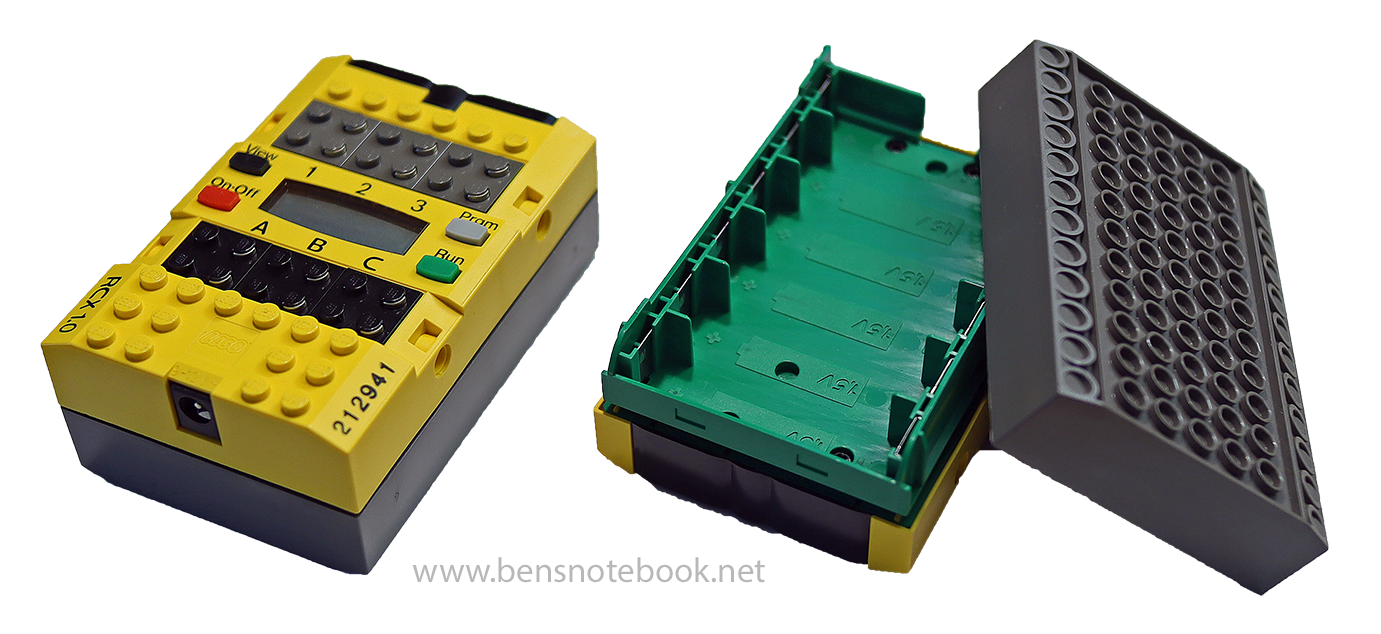
This series of articles will explore the details of the LEGO Mindstorms RCX programmable brick. Since the end of 2024, I have been collecting knowledge about the inner workings of the RCX. I investigated existing firmwares, created some small custom firmwares, and made many interesting discoveries along the way. The RCX Deep Dive series will attempt to organize everything I've learned, most of which is not available anywhere else. My goal is to compile the most complete RCX page on the Internet.
Note: This series is still in active development. I will update and expand these articles in-place as I find the time. There might be red TODO markers for a while. Each page of this site shows the date of last update at the bottom.
Overview
The RCX was the first programmable brick in the now-discontinued Mindstorms line. It features 3 input ports for sensors, 3 output ports for motors/lights, an infrared communication system, a speaker, and a segmented LCD display. Despite the modest specs, the RCX is a quite capable device when paired with good software and robot hardware.
Inside the RCX is a Hitachi (later Renesas) H8/3292 microcomputer. This one chip contains an H8/300 series CPU core clocked at 16 MHz, 16K of built-in ROM, 512 bytes of built-in RAM, and several timers and counters that interface with other components on the PCB.
Versions
The RCX comes in three versions that correspond to the three releases of the Robotics Invention System (RIS) set. All versions have nearly the same capabilities. Several minor PCB revisions exist within each version.
- 1.0 - The casing says 1.0. There is an AC barrel-style power jack at the bottom, making it well suited for static, long-running robots.
- 1.5 - The casing says 1.0, and there is no power jack. The least desirable version.
- 2.0 - The casing says 2.0, and there is no power jack. This is the only version that can talk to Spybots, due to a different IR frequency. I haven't confirmed this yet.
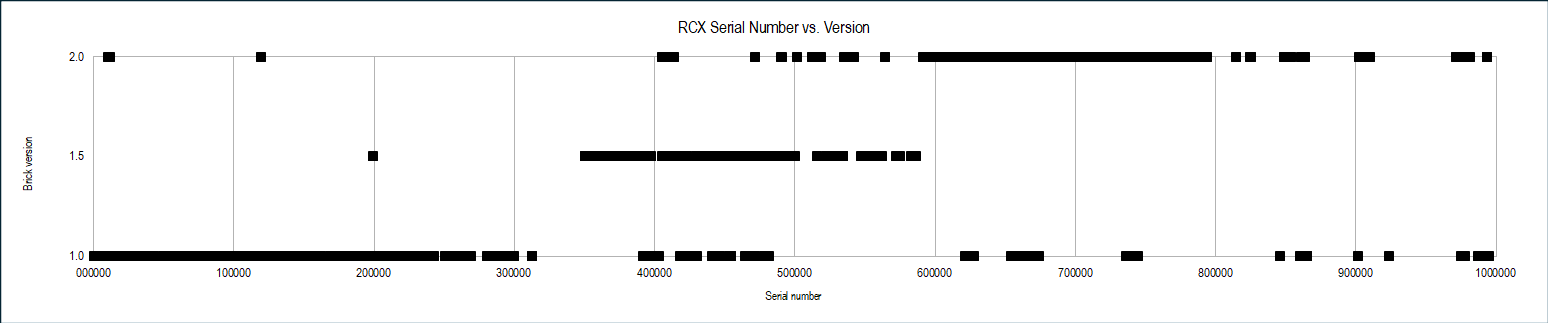
Most units have a six-digit serial number engraved on the casing. No numbers are known to be duplicated. There is a general pattern to these numbers, with a few strange exceptions. After making a spreadsheet with a bunch of RCX serial numbers scoured from the web, I can say that most 1.0 bricks have numbers < 300,000. But some were produced through almost the whole range of numbers. 1.5 bricks have numbers between 350,000 and 600,000, except for one outlier I found under 200,000. Almost all 2.0 bricks are > 400,000 with most > 600,000. Again there are some low-number outliers such as this one. Here is a graph summarizing all this.
A few units have no serial number at all. Leonardo Verde, who did his own research (here), suspects that these were produced after the numbers hit 999,999 and could not expand to 7 digits. So there were likely more than one million RCX units produced in total.